Most financial crises don’t begin with a crash.
They begin with confidence.
Confidence that risk has been “managed.”
Confidence that markets are more sophisticated now.
Confidence that this time is different.
Now that we’ve worked through the examples in this series, we’ve explored a quieter truth:
Modern markets don’t eliminate risk, they rearrange it.
Leverage hasn’t disappeared since the last crisis.
It’s simply become harder to see.
What Invisible Leverage Really Is
Invisible leverage isn’t about fraud or secret schemes.
It’s about structure.
It shows up when:
obligations are shifted instead of recorded
exposure exists without obvious debt
stability depends on confidence rather than flexibility
risk is spread so widely that no one feels responsible for it
On paper, everything looks safer.
In reality, the system becomes more fragile.
That’s the common thread behind every topic in this series.
The Pattern That Keeps Repeating
Across markets and asset classes, the same cycle appears again and again:
Easy financing or abundant liquidity
Financial structures designed to look neutral or low-risk
Growth built on optimistic assumptions
A shift in conditions, rates, demand, volatility, or confidence
Risk reappears, often far from where it originated
This isn’t a conspiracy.
It’s the natural outcome of incentives, complexity, and human behavior.
The Eight Faces of Invisible Leverage
Each post in this series examined a different place where leverage hides, often in plain sight:
Treasury Basis Trades
Turning the world’s “safest” asset into a highly leveraged strategy.
Synthetic Leverage in Derivatives
Exposure without ownership, obligations without balance-sheet debt.
Hidden Debt in Private Equity
Risk embedded in structures that look clean on the surface.
0DTE Options
Intraday leverage creating violent market moves that feel random but aren’t.
Stablecoins and Money-Market Flows
Modern liquidity systems that function like banks, without bank safeguards.
Commercial Real Estate’s Slow Unraveling
Leverage revealed not in a crash, but through time, refinancing, and stress.
Off-Balance-Sheet Financing for AI Data Centers
Massive long-term commitments that don’t appear where most people look.
Different instruments.
Different markets.
Same underlying design.
Why This Matters to Working People
You don’t need to trade derivatives, own commercial property, or invest in private equity to be affected by any of this.
Because the capital behind these structures often includes:
When leverage is hidden and widely shared, the impact doesn’t stay contained.
The pain shows up later as:
Understanding this isn’t about predicting the next crash.
It’s about not being surprised by the mechanics when stress appears.
What This Series Is — and Isn’t
This series is not:
And it’s not about fear.
It is about awareness.
Markets can remain stable for long periods while becoming more fragile underneath.
That fragility only becomes visible when conditions change.
Invisible leverage delays consequences. It doesn’t remove them.
The Bigger Lesson
Across markets, systems, and even personal finances, the same principle applies:
Risk that is ignored doesn’t disappear.
Risk that is hidden doesn’t vanish.
It waits.
Understanding where leverage hides, and how it behaves under stress, is one of the most valuable skills a working person can develop.
Not to trade more.
Not to panic.
But to make clearer, calmer decisions.
A quick note on why I wrote this series:
I’m a blue-collar trader, author, and coach who has spent decades trading and investing in financial markets while working full-time. Along the way, I’ve seen how financial systems often shift risk quietly, and how working people are usually the last to be told where that risk really sits.
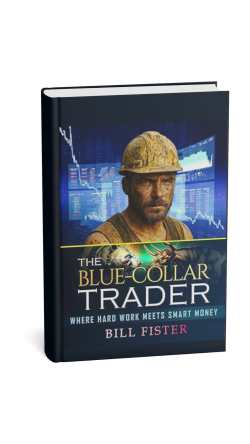
My book, The Blue-Collar Trader: Where Hard Work Meets Smart Money, focuses on discipline, risk management, and emotional control for people trying to build financial independence without burnout or false promises. My other book The American Dream Derailed: How Debt and Deception Shape Our Lives, looks at these same issues from a broader perspective: how debt, incentives, and financial design quietly shape outcomes for working people long before markets ever break.
This series grew out of that same mindset, not to scare anyone, but to help make complex systems easier to understand.
Final Thoughts
The biggest risks in modern markets aren’t loud.
They don’t announce themselves.
They don’t sit neatly on balance sheets.
They’re structural.
They’re shared.
And they’re easy to overlook, until they matter.
That’s what Invisible Leverage is about.
And seeing it clearly is the first step toward protecting what you’ve worked for.
Giveaway Reminder
To close out this series, I’m giving away a signed copy of my book:
The Blue-Collar Trader: Where Hard Work Meets Smart Money
To enter:
Each action counts as one entry.
Thank you to everyone who followed along, questioned assumptions, and engaged thoughtfully throughout this series.
About the Author
Bill Fister is the author of The Blue-Collar Trader: Where Hard Work Meets Smart Money and The American Dream Derailed: How Debt & Deception Shape Our Lives and How We Reclaim Control. Drawing on more than 30 years of market experience while working full-time in a blue-collar profession, he writes about trading discipline, financial systems, and structural risks that affect working-class investors.