In recent years, artificial intelligence has been marketed as the solution to just about everything, from driving cars to diagnosing illnesses. It was only a matter of time before AI was positioned as the answer to one of the most emotionally charged challenges facing working people today: financial security.
Over the last several months, while listening to financial news programming, I repeatedly heard advertisements making claims such as fully automated trading, no experience required, and AI systems that handle execution and risk management on behalf of the user.
What caught my attention wasn’t just the technology being promoted, but the certainty of the language, promises of automation, precision, and consistency, often paired with assurances that traditional trading knowledge wasn’t necessary.
The issue isn’t the use of automation itself; it’s the way certainty is implied without clearly explaining where the risk actually lies.
As someone who has spent decades trading while working full-time, I became curious about how any system could realistically make these claims. That curiosity led me to dig deeper into how AI trading is described, how risk is disclosed, and where the line between marketing language and operational reality lies.
For people working long hours, juggling family responsibilities, and feeling priced out of opportunity, these claims can be incredibly appealing.
But before trusting any system that says it can “trade for you,” it’s worth slowing down and asking a few important questions.
This article isn’t about attacking any company. It’s about helping working-class investors understand how to read between the lines when evaluating AI trading claims.
Why AI Trading Appeals So Strongly to Working People
The appeal is understandable.
Most working people:
Don’t have time to study charts all day
Are exhausted by side-hustle culture
Want leverage, not another job
Feel they’ve done “everything right” and are still falling behind
When an ad promises:
No experience needed
Fully automated execution
AI that adapts to markets
Consistent returns with risk management
…it doesn’t feel greedy to listen. It feels hopeful.
That’s exactly why clarity matters.
What “AI Trading” Can Mean and What It Often Doesn’t
One of the biggest problems in this space is that “AI” is rarely defined.
In practice, AI trading claims can refer to very different things:
Rule-based automation (predefined logic)
Signal generation (alerts, not execution)
Back-end analytics (risk filtering, statistics)
Fully autonomous systems (rare, complex, high risk)
When marketing language doesn’t explain which of these is being offered, consumers are left to assume the best-case scenario.
That assumption is where trouble often starts.
The Difference Between Implied Certainty and Disclosed Risk
Most AI trading promotions include some version of a disclaimer:
“No legitimate financial service can guarantee profits.”
That statement is true, but it doesn’t automatically cancel out the overall impression created by claims such as:
Disclaimers acknowledge risk.
Marketing language sells confidence.
When those two don’t align clearly, the burden falls on the consumer to interpret what’s real.
Questions Every Working-Class Investor Should Ask
Before trusting any AI trading system, here are some basic questions that deserve clear answers:
1. Is the system fully autonomous, or does a human still control decisions?
“Automated” can mean many things. Who is actually responsible when trades go wrong?
2. Are trades executed on real capital or simulated accounts?
This matters enormously for understanding risk, slippage, and real-world performance.
3. How is performance verified?
Is there independent auditing, or is all data self-reported?
4. What does “funded” actually mean?
Does it mean access to capital, simulated buying power, or something else entirely?
5. What happens during prolonged drawdowns?
Every system has losing periods. How are they handled, and who bears the cost?
If these questions don’t have clear, accessible answers, caution is warranted.
As part of my due diligence, I reached out to a company promoting AI-driven automated trading to ask several basic questions about execution, risk, and verification. Although there was continued outreach encouraging a sales conversation, the specific questions themselves were not addressed in writing over the following weeks.
Why Guarantees Often Protect Sales Not Outcomes
Some platforms advertise refunds or “guaranteed evaluations.” These policies may reduce purchase risk, but they do not eliminate trading risk.
A refund protects the transaction.
It does not validate the strategy.
That distinction is important, especially for people already under financial pressure.
A Word on Consistency Claims
Any mention of “targeted weekly returns” should be approached carefully.
Even professional hedge funds, quantitative firms, and institutional desks experience:
When consistency is implied without detailed context, it’s reasonable to ask how those realities are addressed.
Protecting Yourself Without Giving Up Hope
None of this means technology can’t help traders. Automation, risk controls, and data analysis can absolutely reduce emotional mistakes and improve discipline.
But no system removes risk, and no technology replaces informed decision-making.
If something sounds like it eliminates effort, experience, and uncertainty all at once, the most responsible response isn’t excitement, it’s curiosity.
Many of these AI trading promises tap into the same pressure working people feel across the financial system, the belief that if we just find the right tool, the right system, or the right shortcut, things will finally balance out.
In The American Dream Derailed, I explore how that pressure didn’t come from nowhere. It was built over decades through rising costs, stagnant wages, and financial systems that increasingly shift risk onto individuals while selling the illusion of financial security.
AI trading isn’t the problem, misunderstanding risk is. And that misunderstanding shows up everywhere the American Dream is sold without explaining the fine print.
Final Thought
Working people don’t need more hype.
They need clear information.
AI may play a role in the future of trading, but understanding how it’s used matters far more than believing that it’s used.
The goal isn’t to discourage ambition.
It’s to make sure hope is built on understanding, not assumptions.
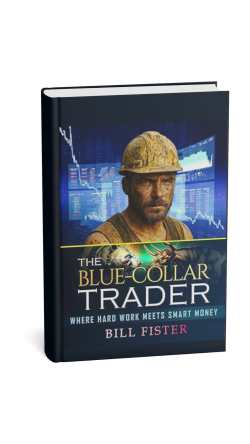
Bill Fister is the author of The Blue-Collar Trader: Where Hard Work Meets Smart Money and The American Dream Derailed: How Debt & Deception Shape Our Lives and How We Reclaim it. With over 30 years of experience trading while working full-time, he focuses on discipline, risk management, and helping working-class investors ask better questions before trusting financial solutions that promise efficiency without explaining risk.